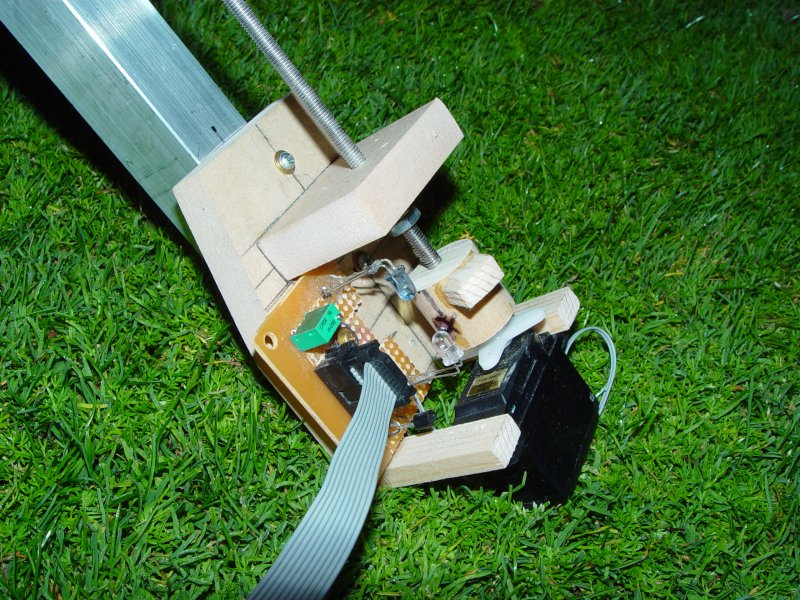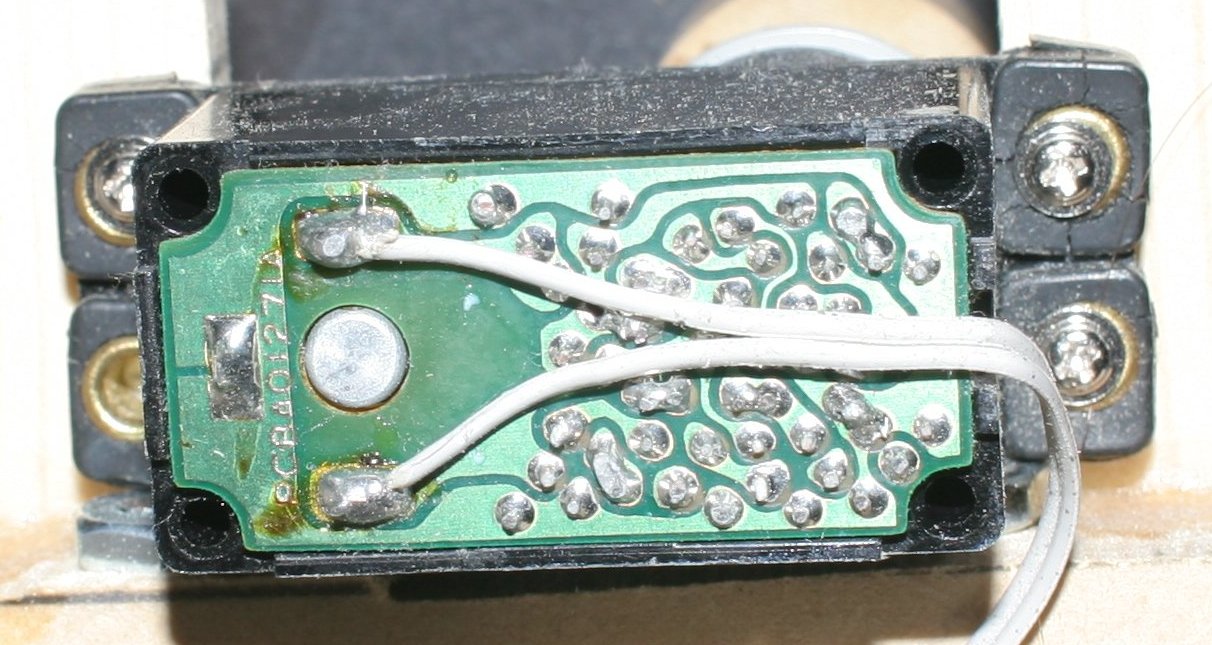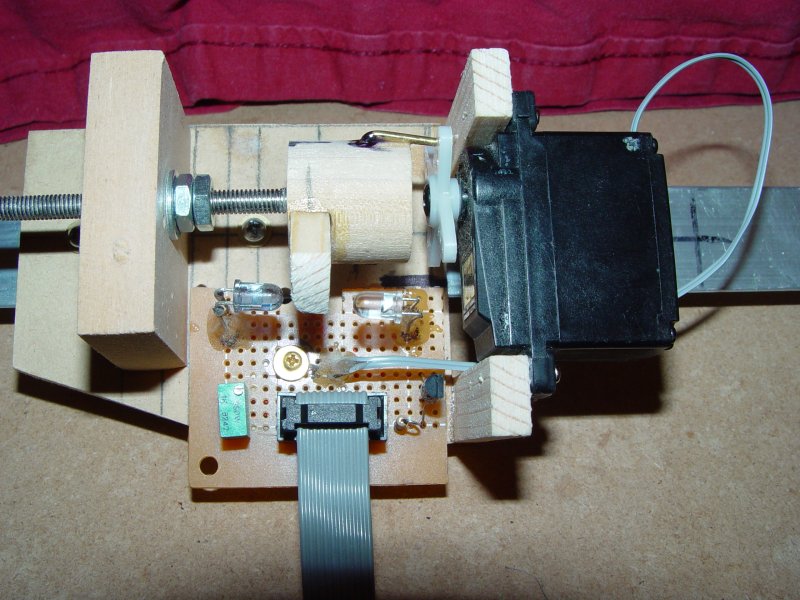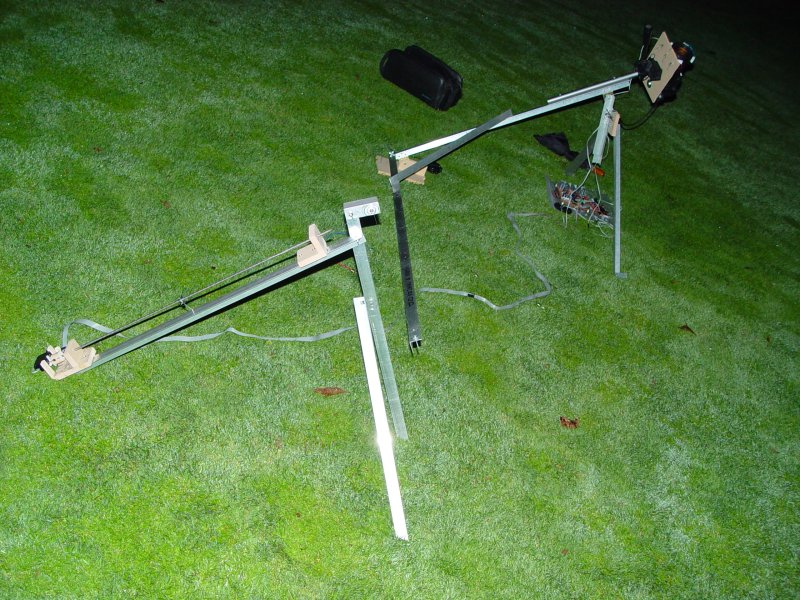


The tachometer and servo turn the corkscrew at a constant RPM. The
servo has been stripped of its feedback potentiometer and rotation
stopper and its motor soldered directly to our H bridge.
Unlike most servo hackers who continue to drive the servo through its
own H bridge, we found a brand new H bridge connected directly to the
servo motor can provide more power and is easier to program. Although
this servo originally ran on 5V, the trapezoid runs it on 9V.
Incidentally this servo was bought in 1988.
The tachometer is simply a piece of wood which interrupts an IR cutoff
sensor. Many other solutions were tried mainly back-EMF and voltage
ripple. Back-EMF didn't work at such a low RPM with very little
intertia. Voltage ripple could give an RPM of the servo but it
required a digital potentiometer to control servo power and it lacked
enough wiper positions to get accurate enough speeds.
Lacking enough money for an enclosure, the photodiode pins had to be
spaced 1/4" apart to prevent condensation and that eliminated the use
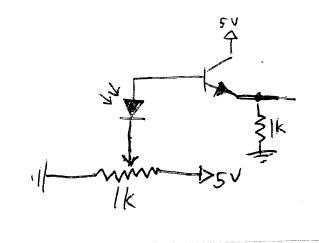
of op-amps for the very weak photodiode signal. A custom preamp had to
be built with the wide pin spacing, directly on the drive.
The theory is the photodiode is reverse biased enough so any rise in
voltage due to the photodiode gets a huge current boost from the
transistor.
The camera platform must be as isolated as humanly possible from the
servo vibration. That meant the drive train had to go on a support
structure and connect by a very long cable.
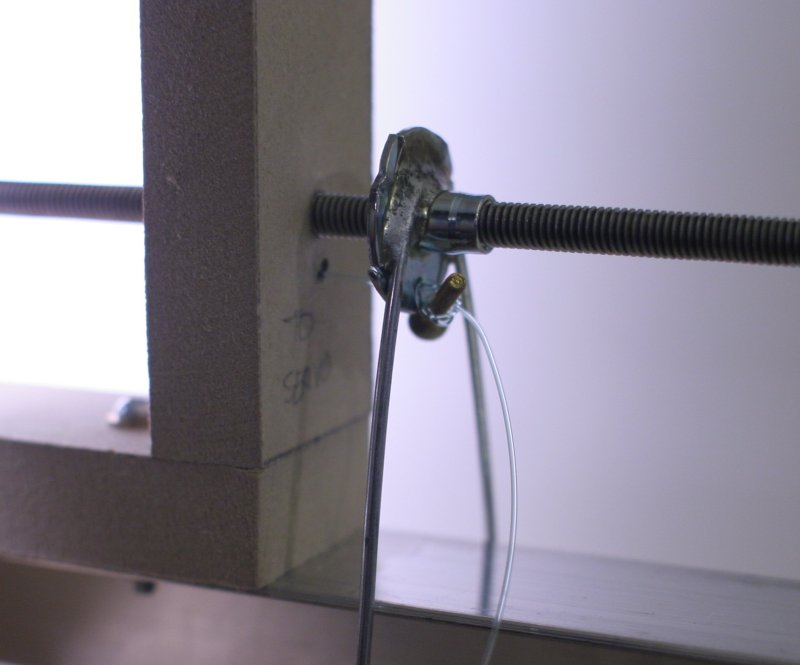
The corkscrew pulls the fishing line.
A number of things minimize the periodic error of this drive train.
The corkscrew is a heavy 10-32 rod to resist bending due to the lateral
servo force.
The fishing line attaches as close as possible to the corkscrew to
minimize longitudinal deflection due to corkscrew bending.
The fishing line pulls on the right ascention arm. Because the fishing
line pulls in a straight line you'd think the angular velocity would
change, but as long as the deflection is under 15° and the least
amount of fishing line hangs out under the right ascention support, the
angular velocity is practically constant.